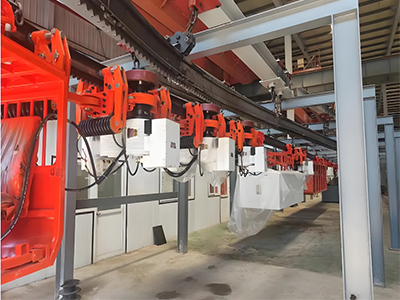
Suspended Monorail Wheels PU Coating Process
In a suspended monorail transit system, wheels serve as the core load-bearing components connecting the train to the track, and their performance directly determines the safety, stability, and comfort of operation. The PU coating process for suspended monorail wheels, as a key technology for optimizing wheel performance, significantly improves the friction performance between the drive wheels and the track by coating the surface of the wheel substrate with polyurethane (PU) material. It provides solid support for the traction output and operation stability of monorail trains, making it one of the core technologies in the field of rail transit equipment manufacturing.

PU Coating Process for Suspended Monorail Wheels: Why Is It the "Performance Code" for Rail Operation?
Suspended monorail trains operate in an "inverted" mode hanging below the track. The wheels must simultaneously bear the train's own weight, passenger load, and lateral track forces. The friction coefficient between the wheels and the track directly affects traction transmission efficiency and braking safety. Traditional uncoated or ordinary rubber-coated wheels are prone to problems such as fast wear, unstable friction performance, and easy hardening at low temperatures, which increase operation and maintenance costs as well as potential safety hazards.
Polyurethane (PU) material possesses excellent wear resistance, controllable friction coefficient, good high and low temperature resistance, and strong adhesion. When combined with the wheel's cast iron core through a professional coating process, it can achieve three core advantages: first, optimizing friction matching to maintain the friction coefficient between the drive wheel and the track within the optimal range, thereby improving traction transmission efficiency; second, extending service life—PU coating has 3-5 times the wear resistance of ordinary rubber, significantly reducing the frequency of wheel replacement; third, enhancing operation stability—the good elasticity of the coating can buffer the impact caused by track irregularities and reduce operation noise and vibration. It is these advantages that make the PU coating process the core technical choice for the manufacturing and renovation of suspended monorail wheels.
Detailed Explanation of the Core Process of PU Coating for Suspended Monorail Wheels
The core of the PU coating process lies in the precise control of "substrate treatment - interface bonding - coating formation". Negligence in any link may lead to problems such as coating peeling and uneven wear. The following is a standardized core process verified by the industry:
1. Pre-treatment: Substrate Cleaning and Renovation Repair
Pre-treatment is a key step determining the bonding strength between the coating and the cast iron core, and differentiated treatment plans must be adopted according to the wheel type (new wheel/renovated wheel):
New Wheel Cast Iron Core Treatment: The surface of a newly cast wheel iron core is prone to residual casting oil, oxide scale, and dust. It is first cleaned with a neutral industrial cleaning agent using ultrasonic waves to completely remove surface oil. Then, it is dried with hot air (temperature controlled at 80-100℃) to ensure the surface of the iron core is dry and free of moisture, preventing bubbles in the subsequent coating.
Renovated Wheel Treatment: For old wheels that need to be reused, special mechanical stripping equipment is first used to remove the failed old PU coating or rubber layer to avoid damaging the cast iron core substrate. Then, a high-pressure spray cleaning agent is used to rinse off residual rubber debris and aged impurities on the surface. For stubborn residues, manual grinding is used for auxiliary cleaning. Finally, flaw detection is carried out to check for defects such as cracks and deformation in the iron core, ensuring the substrate is qualified before proceeding to the next process.
2. Surface Bonding Treatment: Roughening and Activation (Enhancing Interface Bonding Force)
The surface of the cast iron core is smooth, and direct PU coating is prone to insufficient adhesion. Dual treatment of physical roughening and chemical activation is required to increase the bonding area and interface force:
First, mechanical roughening treatment is carried out. The surface of the iron core is sprayed using a quartz sandblasting process. The sand particle size is 80-120 mesh, and the sandblasting pressure is controlled at 0.4-0.6MPa, so that the surface of the iron core forms a uniform rough texture (surface roughness Ra value reaches 1.5-2.0μm), which greatly increases the contact area with the PU coating. Immediately after sandblasting, compressed air is used to blow off surface sand and dust to avoid residual impurities affecting bonding.
Subsequently, chemical activation treatment is performed. A special polyurethane primer is applied to the roughened iron core surface. The primer can penetrate into the tiny pits on the surface to form chemical anchor points, further improving the adhesion between the PU coating and the substrate. After application, it is left to stand at room temperature for 30 minutes to ensure the primer is fully dried.
3. PU Coating Formation: Precision Casting and Curing (Ensuring Stable Coating Performance)
The coating formation link requires strict control of material ratio, casting temperature, and curing parameters to ensure uniform and stable coating performance:
First, according to the wheel size and performance requirements, polyurethane prepolymer and curing agent are mixed in proportion (usually a ratio of 100:10-15). After mixing, a high-speed stirring device is used to stir for 2-3 minutes to ensure uniform mixing and no bubbles. Then, the mixed PU material is injected into a special mold, and the pre-treated iron core is accurately positioned in the mold to ensure uniform coating thickness (usually controlled at 15-25mm).
After casting, the mold is sent to a constant temperature curing oven for staged curing: the first stage is curing at 60℃ for 2 hours to initially form the coating; the second stage is heating to 80℃ for 4 hours to promote sufficient internal chemical reactions of the coating and improve coating strength and wear resistance. After curing, it is naturally cooled to room temperature, and then demolding and subsequent trimming are carried out.
4. Quality Inspection: Multi-dimensional Control of Finished Product Performance
To ensure the coated wheels meet operation requirements, multi-dimensional quality inspection is required: first, adhesion testing—the cross-cut method is used to test the bonding force between the coating and the iron core to ensure no coating peeling; second, dimensional accuracy testing—a coordinate measuring machine is used to test key dimensions such as wheel diameter and roundness, with an error controlled within ±0.1mm; third, friction performance testing—the friction coefficient is tested in a simulated track environment to ensure it meets traction transmission requirements; fourth, wear resistance testing—accelerated wear tests are used to evaluate the service life of the wheels to ensure they meet operating mileage requirements.
Core Application Scenarios of PU Coating Process for Suspended Monorail Wheels
With excellent performance, PU-coated wheels are widely used in various suspended monorail transit scenarios, including:
Urban Commuting Suspended Monorails: In densely populated urban commuting lines, PU-coated wheels can withstand high-frequency starts and stops and heavy-load operation, reducing wheel wear and maintenance frequency and lowering operation costs. Their good shock absorption performance also improves passenger comfort and travel experience.
Scenic Spot Sightseeing Suspended Monorails: Sightseeing suspended monorails in scenic spots usually operate in areas with complex terrain, where the track is prone to undulations and curves. The stable friction performance of PU-coated wheels can ensure the train's traction and braking safety under complex road conditions, while their low-noise characteristics can reduce interference to the scenic environment.
Industrial Plant Suspended Monorails: Suspended monorails in industrial plants are mostly used for material transportation. The wheels need to adapt to heavy-load and dusty working environments. The wear-resistant and oil-resistant properties of PU-coated wheels can improve equipment reliability and reduce production interruptions caused by wheel failures.
Customized PU Coating Solutions to Enhance Rail Operation Quality and Efficiency
Suspended monorail wheels in different scenarios have different requirements for PU coating parameters such as hardness, friction coefficient, and thickness. We have been deeply engaged in the PU coating process for suspended monorail wheels for many years and possess core technologies covering the entire process from substrate treatment to finished product inspection. We can customize exclusive coating solutions according to customers' vehicle parameters, operation scenarios, load requirements, etc. Whether it is new wheel manufacturing or old wheel renovation, we can ensure the product performance reaches the industry-leading level.
If you are looking for an effective solution to improve the performance of suspended monorail wheels, or need further technical consultation on the PU coating process for suspended monorail wheels, please feel free to contact us. We will provide you with professional technical support and customized services to jointly enhance the quality and efficiency of rail transit operation!