How to Save 20% on Forklift Maintenance
In today's highly developed automated warehousing and logistics landscape, forklifts serve as the "capillaries" of the supply chain. As the sole point of contact between the forklift and the ground, load wheels directly impact operational efficiency, cargo safety, and even a company’s legal liabilities. Many warehouse managers fall into the trap of believing a wheel is "good as long as it’s not in pieces"—a misconception that costs companies thousands in hidden expenses every year.
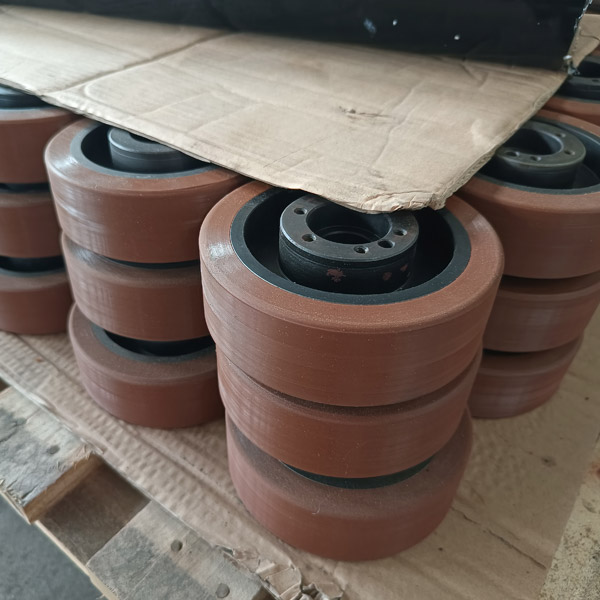
This article provides a deep dive into the "Golden Window" for load wheel replacement from technical, safety, and economic perspectives.
I. The "10% Rule": The Science Behind Wear Limits
Forklift load wheels typically consist of a steel hub and an outer layer of Polyurethane. This layer acts as both a wear-resistant surface and a shock absorber.
Industry standards recommend replacement when the wheel diameter has worn by more than 10% of its original size. This is not an arbitrary figure:
Ground Clearance Reduction: A smaller wheel diameter brings the chassis closer to the ground. When navigating ramps, speed bumps, or uneven floors, the vehicle is prone to "bottoming out," damaging expensive drive motors or hydraulic lines.
Decreased Load Capacity: As the polyurethane thins, its ability to recover from deformation weakens. The pressure per unit area spikes, leading to internal heat buildup and eventual structural failure.
II. The Silent Killers: Flat Spots and Abnormal Vibration
If you hear a rhythmic "thump-thump" in the warehouse or see the mast trembling even when empty, the wheels are "signaling" for help.
What are "Flat Spots"?
When a forklift is left fully loaded in one spot for an extended period, or if an operator brakes hard (skidding the wheels), the polyurethane undergoes permanent plastic deformation or flat-surface abrasion.
The "Butterfly Effect" of Vibration
On Drivers: High-frequency vibrations travel through pedals and handles. Research shows that operators exposed to long-term Whole Body Vibration (WBV) have a 40% higher incidence of lumbar spine disease.
On Precision Cargo: When moving electronics or fragile chemicals, the jolts from flat spots can damage internal components, leading to costly returns.
On Electronics: Modern forklifts are packed with sensors and controllers. Constant vibration is a leading cause of cracked solder joints and loose connectors.
III. Structural Failure: Bond Failure and Chunking
Bond Failure (Delamination)
This is the most dangerous failure mode. Due to prolonged overloading or excessive speed, the chemical bond between the metal hub and the polyurethane breaks.
Signs: Bubbling or bulging on the surface, or a "squelching" sound during movement.
Consequences: The polyurethane may peel off entirely during high-speed travel or turns, causing the forklift to lose balance and tip over instantly.
Chipping & Chunking
In environments with wood chips, gravel, or metal debris, wheels can get gouged.
Replacement Standard: If a cut is deeper than 1/3 of the polyurethane thickness or wider than 20% of the wheel width, it must be replaced. These gaps become stress concentration points that lead to total tearing.
IV. The Golden Rule: Why Replace in Pairs?
This is the most overlooked detail in maintenance: Never replace just one load wheel.
Lean Caused by Diameter Difference: Even a 5mm difference at the base can result in a horizontal deviation of over 10cm at a 10-meter lift height. This makes positioning difficult and risks racking collisions.
The Vicious Cycle of Uneven Load: When mixing new and old wheels, the new (larger) wheel will bear over 70% of the vertical pressure, causing it to fatigue prematurely. Replacing in pairs is actually a cost-saving measure.
V. Advanced Maintenance: Extending Wheel Life
Clear Debris: Check axles daily. Plastic strapping and shrink wrap are "gallows" for bearings; the friction heat they generate can burn oil seals and cause delamination.
Floor Management: Keep floors dry and clean. Oil corrodes polyurethane, while water reduces friction, leading to "flat spots" during braking.
Proper Parking: Never leave a forklift fully loaded overnight.
Summary
Load wheels are small, but they represent the baseline for forklift safety and efficiency. Shifting from "fix it when it breaks" to preventive replacement not only protects employees but can reduce a company’s comprehensive O&M costs by 15–20% by minimizing downtime and secondary part damage.